一年过去了,在七拼八凑下,影协一帮老家伙们又碰头了。
这一年都有些什么变化呢……
上次是Joeytry的喜糖,这次是Phinix的喜糖。
而已婚男人Joeytry同学重新回到了青年公寓,正为下一篇论文发愁着。
上次缺席的Jinglei同学这次不仅带了夫人,还带了大眼的小宝宝,当然还有他重新返校读书的消息。这位仁兄本科学的新闻,硕士学的管理,去英格兰游历了一番后又到新东方去忽悠了几天一门心思想出国的小朋友们,现在又去未名湖畔研究哲学去了。
为了Ph.D学位抗战快八年的Pluto还是那么腼腆安静,据说出头的日子快来了,祝福之。这么几年的时间,爷爷奶奶们把日本鬼子都赶出中国了,当子孙的要是连个纸片片都搞不定,那也无颜活在这个和平的世界了。
Lonski脱光了,可惜没有看到真人,也没有照片。欧洲公司确实比美洲公司更人性化、更懂享受生活,几天不见,这个小伙子已经和同事一道出没于Angel Club, Babyface和唐会之类的场所了。
Robin在Lenovo Research做Linux Smart Phone,我们给他提了一个Idea: CUI based mobile phone.上市之后一定可以得到Geek一代的追捧。
Adihe同学也有变化,穿上了难得一见的白色连衣裙,其间点缀着星罗棋布的红点,倒有几分蝴蝶的味道。
Spreader同学同样也看到了胜利的曙光,但是手头正有一个Conference的dead line,吃饭似乎也都没甚胃口。
Jinglei夫妇为了我们中的光光着想,还带来了自己本科的一位mm,用意大家都知道,只是最后好想似乎都没什么下文。其实到现在都还悬着的,总是有自己各种各样的考虑,一时半会很难破局。
而我这位标准的IT民工呢,工作一年了还是一副落魄学生的打扮,听起来好像变了不少,其实一切还是老样子,什么都没变,全在原地东张西望着。
去年聚会,我们还是在谈论着八卦、娱乐、活动。而今年,我们大部分都在谈论着婚嫁、生儿育女、股票基金、房价工资,偶有提到现在协会的情况,但是我们好像已经完全忘了电影,忘了我们头上顶着的名号。这就是所谓岁月流逝,这就是所谓平淡生活。不知不觉中,我们还是被这该死的社会改造了,不少人在这个改造中,努力不再记得自己曾经是谁……
饭毕去翠宫玩保龄球,在下宝刀未老,前两局勇夺全场最高分,然而不幸于第三局晚节不保,白白浪费两次Double,十球下来,沦落到倒数第一!明显的体力不支导致的动作变形,看来应该加强锻炼了。
说到锻炼,我的Bodyworks的会员卡到现在也没消费过几次,这一年马上就要到期了,不知道又便宜了那帮吃闲饭的人多少会费。
今天面对众人,说的是一年之后,而明年这个时候,回首往事,似乎也用得上“十年之后”这样的短语了。妈的,“十年之后”这样的混帐短语也能应用到自己身上了。
时光总是在这样不经意间就偷偷溜走,你所能做的,只有无奈地向她挥挥手,然后努力让下一个十年回首的时候不再那么沧桑无奈……
6/17/2007
6/14/2007
向刘润老师学习
那些不能把你击倒的,终将使你变得更加坚强
不要高估自己的实力,不要低估自己的潜力
一个人之所以成功
不是因为他改正了所有的缺点
而是最大程度地发挥了自己的优点
在生活中
一些东西可以去学
另一些东西需要去悟
还有一些东西,则是需要去闯
哪怕一开始撞得头破血流……
Reference:
面对变化的思考
榨干你所能学习的一切东西
时间管理三招
“自己2.0”
不要高估自己的实力,不要低估自己的潜力
一个人之所以成功
不是因为他改正了所有的缺点
而是最大程度地发挥了自己的优点
在生活中
一些东西可以去学
另一些东西需要去悟
还有一些东西,则是需要去闯
哪怕一开始撞得头破血流……
Reference:
面对变化的思考
榨干你所能学习的一切东西
时间管理三招
“自己2.0”
6/05/2007
The Hitchhiker’s Guide to the ∑- GALAXY
The Hitchhiker’s Guide to the ∑- GALAXY
Part I – Introduction
"To know the road ahead, ask those coming back."
- Chinese proverb
In the beginning, there was NEO. And for a while, it was good. Then someone said, “Let there be some guides besides that!”. And here it is ......
PART II – Work [Mainly for Coding Guys, NOT for Papering Guys]
First of All, Remember Where this Space is Located:
1. It’s located at 39°58'32.60"N, 116°19'52.35"E and just looks like this and also this
2. Don’t forget to come to this fantastic place every morning, when you wake up with a feeling of exciting for difference technology will make for people's life.
Then you can ……
Get to Know $, ∑ and Your Team:
1. $ Internal Portal. http://$w
2. ∑ Internal Portal. http://∑
3. Your Team Internal Portal. Depends on your group, X’s portal is located at http://teamsomewhere/sites/X/default.aspx .
Get Hardware/Software Access
1. $ Beijing File Server. \\/\|-=-
2. ∑ File Server. \\∑
3. ∑ IT support.
a. Alias: ∑IT
b. Phone: 38**
4. All software on these severs are free and have register key embedded, no need to crack, no need to search a valid CD Key from Baidu ,Google or Live.
Get Familiar with ∑ Development Environment:
Option One: Using internal tools
1. Source Control: ** - http://**/Pages/default.aspx
2. Build Tool: ++XT - http://++xt
3. Editor: Visual Studio [VI/EMACS is also permitted as far as this guide’s author know]
Option Two: Using Visual Studio Team System
1. Source Control: Team Foundation Server
2. Build: MSBuild
3. IDE: Visual Studio
4. Go to MSDN for these tools’ documentation.
Script Language
1. With Power Shell, you can throw away batch file and command window now.
2. Internal Portal: http://@@/Pages/default.aspx
Do Some Performance Profiling
1. Visual Studio Integrated Tool:
a. Access Path in VS 2005: VS->Tool->Performance Tools;
b. VS Performance Team Site: http://team/sites/!#$/^&*/default.aspx
2. Office Profiler:
a. http://!@#$%^&*
Or You can Make Code Analysis
1. FxCop for Managed code
2. PREfast for native code
3. VS Code Analysis Team Site: http://*&^%$#@!/Home.aspx
Then Have a Look at Our ∑ Internal Tools:
1. ∑ Jump Start
a. To Share Your Knowledge With Colleagues, please go to ∑ Jump Start: http://$wikis/∑jumpstart/Wiki%20Pages/Home.aspx
2. MOT
a. Want to resolve more algorithm/data structure problems than what you had done in your interview? Please go to ∑ Online Training site: http://...
3. Springfield
a. When you feel you are short of labor force, please go to Springfield to hire intern: http://,,,
4. XXX Brown Bag
a. XXX Brown Bag is a regular meeting for group members to share the latest technical information and new technology
b. You can find the historical documents and slides HERE.
PART III – Life [Drinking , Eating && Playing]
We have dining room in B1, which is not free, but most likely, you will never pay for it using cash.
We have cookies, little bread and popular instant noodles in our front desk.
We have Coca Cola, Pepsi and other similar drinks in the refrigerator of our tea room. [Yes, totally free]
We have a fruit time at 3:00 PM, every work day, which is happed in tea room.
So, we also have food within one hundred paces, although we have no super Chef, nor luxurious “乌鸡甲鱼汤”.
You eat, you drink, and so you need to do another stuff. Fortunately, there are Water Closets in every floor, which will meet this kind of requirement. Use your nose to locate them - corporation service team put so much perfume in those rooms, you can smell it beyond 100 paces.
If you need to entertain yourself, we have table tennis, foosball, billiards and cool Xbox 360 games in 4th and 5th floor’s lunge room.
If you want to do some “add water” stuff, we have a most powerful web2.0 application called Tango. Please go there to find those interesting undocumented features. The more time you spend on investigating it, the happier you will be. As to the unexpected behavior or so called bug, be patient about it. Tango dev team will deploy the latest version weekly, most likely it will get fixed in next deployment.
PART IV – Conclusion
We know you come here to follow your heart, it’s really great and welcome! You will make big progress as time goes by, because there are so many stuff you need to learn and get familiar with.
Your FTE career in ∑ will start in a cool training. Your training instructors are very experienced and nice, you can learn a lot from them. But as to the training projects, I can only say, “MAY THE FORCE BE WITH YOU!”.
Welcome to ∑, welcome to the HOTTEST lab on this planet! (You will know how hot it is this winter, especially for those sitting in XXX corner)
Best Regards
-It's Me
Part I – Introduction
"To know the road ahead, ask those coming back."
- Chinese proverb
In the beginning, there was NEO. And for a while, it was good. Then someone said, “Let there be some guides besides that!”. And here it is ......
PART II – Work [Mainly for Coding Guys, NOT for Papering Guys]
First of All, Remember Where this Space is Located:
1. It’s located at 39°58'32.60"N, 116°19'52.35"E and just looks like this and also this
2. Don’t forget to come to this fantastic place every morning, when you wake up with a feeling of exciting for difference technology will make for people's life.
Then you can ……
Get to Know $, ∑ and Your Team:
1. $ Internal Portal. http://$w
2. ∑ Internal Portal. http://∑
3. Your Team Internal Portal. Depends on your group, X’s portal is located at http://teamsomewhere/sites/X/default.aspx .
Get Hardware/Software Access
1. $ Beijing File Server. \\/\|-=-
2. ∑ File Server. \\∑
3. ∑ IT support.
a. Alias: ∑IT
b. Phone: 38**
4. All software on these severs are free and have register key embedded, no need to crack, no need to search a valid CD Key from Baidu ,Google or Live.
Get Familiar with ∑ Development Environment:
Option One: Using internal tools
1. Source Control: ** - http://**/Pages/default.aspx
2. Build Tool: ++XT - http://++xt
3. Editor: Visual Studio [VI/EMACS is also permitted as far as this guide’s author know]
Option Two: Using Visual Studio Team System
1. Source Control: Team Foundation Server
2. Build: MSBuild
3. IDE: Visual Studio
4. Go to MSDN for these tools’ documentation.
Script Language
1. With Power Shell, you can throw away batch file and command window now.
2. Internal Portal: http://@@/Pages/default.aspx
Do Some Performance Profiling
1. Visual Studio Integrated Tool:
a. Access Path in VS 2005: VS->Tool->Performance Tools;
b. VS Performance Team Site: http://team/sites/!#$/^&*/default.aspx
2. Office Profiler:
a. http://!@#$%^&*
Or You can Make Code Analysis
1. FxCop for Managed code
2. PREfast for native code
3. VS Code Analysis Team Site: http://*&^%$#@!/Home.aspx
Then Have a Look at Our ∑ Internal Tools:
1. ∑ Jump Start
a. To Share Your Knowledge With Colleagues, please go to ∑ Jump Start: http://$wikis/∑jumpstart/Wiki%20Pages/Home.aspx
2. MOT
a. Want to resolve more algorithm/data structure problems than what you had done in your interview? Please go to ∑ Online Training site: http://...
3. Springfield
a. When you feel you are short of labor force, please go to Springfield to hire intern: http://,,,
4. XXX Brown Bag
a. XXX Brown Bag is a regular meeting for group members to share the latest technical information and new technology
b. You can find the historical documents and slides HERE.
PART III – Life [Drinking , Eating && Playing]
We have dining room in B1, which is not free, but most likely, you will never pay for it using cash.
We have cookies, little bread and popular instant noodles in our front desk.
We have Coca Cola, Pepsi and other similar drinks in the refrigerator of our tea room. [Yes, totally free]
We have a fruit time at 3:00 PM, every work day, which is happed in tea room.
So, we also have food within one hundred paces, although we have no super Chef, nor luxurious “乌鸡甲鱼汤”.
You eat, you drink, and so you need to do another stuff. Fortunately, there are Water Closets in every floor, which will meet this kind of requirement. Use your nose to locate them - corporation service team put so much perfume in those rooms, you can smell it beyond 100 paces.
If you need to entertain yourself, we have table tennis, foosball, billiards and cool Xbox 360 games in 4th and 5th floor’s lunge room.
If you want to do some “add water” stuff, we have a most powerful web2.0 application called Tango. Please go there to find those interesting undocumented features. The more time you spend on investigating it, the happier you will be. As to the unexpected behavior or so called bug, be patient about it. Tango dev team will deploy the latest version weekly, most likely it will get fixed in next deployment.
PART IV – Conclusion
We know you come here to follow your heart, it’s really great and welcome! You will make big progress as time goes by, because there are so many stuff you need to learn and get familiar with.
Your FTE career in ∑ will start in a cool training. Your training instructors are very experienced and nice, you can learn a lot from them. But as to the training projects, I can only say, “MAY THE FORCE BE WITH YOU!”.
Welcome to ∑, welcome to the HOTTEST lab on this planet! (You will know how hot it is this winter, especially for those sitting in XXX corner)
Best Regards
-It's Me
5/30/2007
读书笔记 - The Tipping Point, Part III
The last thing Gladwell mentioned is about the Environment. He named the affect of environment as "the Power of Context (环境力量法则)" and pointed out that "Human behavior is strongly influenced by external variables of context". To make it more clear, he summarized it as the following rules/theories:
Broken Window Theory[3]
“If a window is broken and left unrepaired, people walking by will conclude that no one cares and no one is in charge. Soon, more windows will be broken.”
So, if you deployed a web site externally, be careful about the features you promised. If there is any feature that didn't keep your promise, people will doubt on other features and they may think your whole system is not so stable and it may also doesn't have product level quality. This will harm your success.
Bystander Effect
It says that "a psychological phenomenon in which someone is less likely to intervene in an emergency situation when others are present than when he or she is alone."
There was a crime in New york 1964. A women was killed under the sight of her 38 neighbors, it lasted for about half an hour, but no one called the policeman. The public blame those witness be be cold blooded. But some psychological research results show that, it's just an normal human reaction when they know other people may also see it. Every body think some other people will call the police, so no one called by their own. It's just humanity, nothing related to these people's morale level, those researcher said.
I think this give us a good hint that, when you are managing a team to accomplish some tasks, you'd better assign your task explicitly and clearly to individual members. This will reduce the bystander effect.
Rule of 150[4]
Another thing Gladwell mentioned is that, according to some scientific research result: "Human Beings can only have stable social relationships with about 150 people, due to some biological limitation in our brain."
Thus, any group larger than this will automatically segment into factions and decrease efficiency. The existence of small groups helps the spread of a message because each member of the group knows each other very well.
So if you want something to get popular through a social network, you should turn this kind of social network/organization structure
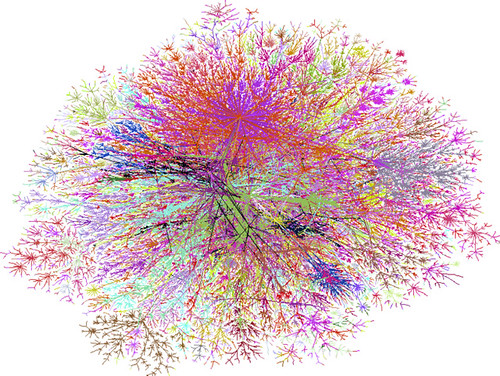
in to this
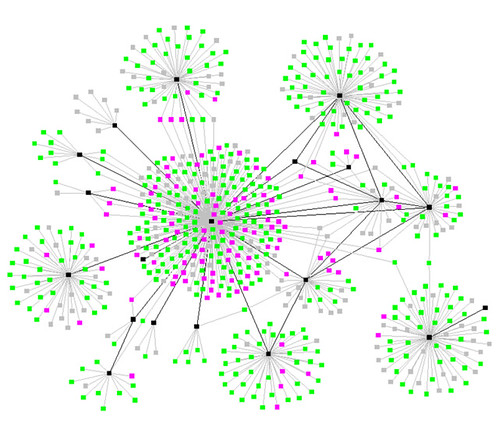
This will undoubtedly improve the efficiency of your organization.
In a word, I think Gladwell did a great job on explaining those social epidemics, although whether these conclusions can really help us to make things get popular is not proved in this book.
Anyway, the author of the book gave us some very good suggestions we can take a look and have a try, maybe it will help our success.
Reference:
[3]”Broken Window”, http://en.wikipedia.org/wiki/Fixing_Broken_Windows
[4] “Rule of 150”, http://en.wikipedia.org/wiki/Dunbar%27s_number
Broken Window Theory[3]
“If a window is broken and left unrepaired, people walking by will conclude that no one cares and no one is in charge. Soon, more windows will be broken.”
So, if you deployed a web site externally, be careful about the features you promised. If there is any feature that didn't keep your promise, people will doubt on other features and they may think your whole system is not so stable and it may also doesn't have product level quality. This will harm your success.
Bystander Effect
It says that "a psychological phenomenon in which someone is less likely to intervene in an emergency situation when others are present than when he or she is alone."
There was a crime in New york 1964. A women was killed under the sight of her 38 neighbors, it lasted for about half an hour, but no one called the policeman. The public blame those witness be be cold blooded. But some psychological research results show that, it's just an normal human reaction when they know other people may also see it. Every body think some other people will call the police, so no one called by their own. It's just humanity, nothing related to these people's morale level, those researcher said.
I think this give us a good hint that, when you are managing a team to accomplish some tasks, you'd better assign your task explicitly and clearly to individual members. This will reduce the bystander effect.
Rule of 150[4]
Another thing Gladwell mentioned is that, according to some scientific research result: "Human Beings can only have stable social relationships with about 150 people, due to some biological limitation in our brain."
Thus, any group larger than this will automatically segment into factions and decrease efficiency. The existence of small groups helps the spread of a message because each member of the group knows each other very well.
So if you want something to get popular through a social network, you should turn this kind of social network/organization structure
in to this
This will undoubtedly improve the efficiency of your organization.
In a word, I think Gladwell did a great job on explaining those social epidemics, although whether these conclusions can really help us to make things get popular is not proved in this book.
Anyway, the author of the book gave us some very good suggestions we can take a look and have a try, maybe it will help our success.
Reference:
[3]”Broken Window”, http://en.wikipedia.org/wiki/Fixing_Broken_Windows
[4] “Rule of 150”, http://en.wikipedia.org/wiki/Dunbar%27s_number
5/25/2007
读书笔记 - The Tipping Point, Part II
As to the stuff itself, Gladwell summarized it as - the Stickiness Factor(附着力法则): "The quality that compels people to pay close, sustained attention to a product, concept, or idea."
To get user stuck, Gladwell suggested the followings:
1.Simple and Intuitive UI. Don't make the user think, no more effort is needed to use it.
2.Make it Practical and Personal: user can complete the operations easily, and let user feel the view is specific to him/her.
3.Interactive with User: Let user feel involved, let user feel being part of the whole system.
Let's use the Internet industry as study case. In web design community, there is a popular book named "Don't Make Me Think". The main idea is the same as Gladwell pointed: simple and intuitive user interface, then there will be little cost for the user to try the features you provide.
Personalized view is another core value of modern web applications. In past time, there were many portal web sites, like yahoo, cnn, msn etc. When people visit these sites, every one get the same thing, nothing different. But people are different, they have various interests and personal preferences, they wish to own their personalized view of these information. As web information keep on exploding, the need for customization keep on rising. Many pioneer content provider now exploit these results, they provide personalized view of their content. For example, Yahoo provide myYahoo, and CNN provide rss feed that user can subscribe, both enable the personalized view of the whole content.
As to the "Interactive with user" principle, I think this is the most important character that makes web 2.0 differ from conventional web 1.0. In web 1.0 age, the web site owner is the creator of all the content, they determine what the site looks like, what user will get. While in web 2.0 ages, the user of the web site created the content, they have control on the finally view of the whole system. For example, in Digg, Slashdot, there is no such positions as editor, every user is author and editor. You can submit news to the site, you can rank/comment it, which will affect the finally popularity of this news.
Another observation is from modern search engines. Nowadays, both Google and Yahoo provide login/personalized search. These search engines will record your search history and will use these information to customize/tune your search result, which will form a good feedback loop to improve the search quality. This feature exploits both "Personalized view" and "Interactive with user", although there were some privacy risks.
When you interactive with the web application, when you submit content and when you got personalized view of the content, you feel like becoming part of the whole system. You will never think of leaving out of it, because you lose too much if you do so.
Thus, the web site get you stuck to it successfully, which forms another important factor of making something get popular as Gladwell pointed out in this book.
[To be continue]
To get user stuck, Gladwell suggested the followings:
1.Simple and Intuitive UI. Don't make the user think, no more effort is needed to use it.
2.Make it Practical and Personal: user can complete the operations easily, and let user feel the view is specific to him/her.
3.Interactive with User: Let user feel involved, let user feel being part of the whole system.
Let's use the Internet industry as study case. In web design community, there is a popular book named "Don't Make Me Think". The main idea is the same as Gladwell pointed: simple and intuitive user interface, then there will be little cost for the user to try the features you provide.
Personalized view is another core value of modern web applications. In past time, there were many portal web sites, like yahoo, cnn, msn etc. When people visit these sites, every one get the same thing, nothing different. But people are different, they have various interests and personal preferences, they wish to own their personalized view of these information. As web information keep on exploding, the need for customization keep on rising. Many pioneer content provider now exploit these results, they provide personalized view of their content. For example, Yahoo provide myYahoo, and CNN provide rss feed that user can subscribe, both enable the personalized view of the whole content.
As to the "Interactive with user" principle, I think this is the most important character that makes web 2.0 differ from conventional web 1.0. In web 1.0 age, the web site owner is the creator of all the content, they determine what the site looks like, what user will get. While in web 2.0 ages, the user of the web site created the content, they have control on the finally view of the whole system. For example, in Digg, Slashdot, there is no such positions as editor, every user is author and editor. You can submit news to the site, you can rank/comment it, which will affect the finally popularity of this news.
Another observation is from modern search engines. Nowadays, both Google and Yahoo provide login/personalized search. These search engines will record your search history and will use these information to customize/tune your search result, which will form a good feedback loop to improve the search quality. This feature exploits both "Personalized view" and "Interactive with user", although there were some privacy risks.
When you interactive with the web application, when you submit content and when you got personalized view of the content, you feel like becoming part of the whole system. You will never think of leaving out of it, because you lose too much if you do so.
Thus, the web site get you stuck to it successfully, which forms another important factor of making something get popular as Gladwell pointed out in this book.
[To be continue]
Subscribe to:
Posts (Atom)